
Email marketing is not a dead thing. It is the single most high ROI marketing channel, making it more significant for digital marketing solutions in 2026. While it is visible, AI-based algorithms are regulating the businesses reach and paid ads are facing higher cost per click (CPCs), email campaigns deliver direct, permission-based communication to an audience that chose to hear from you. Reported by Litmus’s 2026 State of Email Report, every $1 invested in email marketing returns an average of $42, a figure no other channel consistently matches.
In this rising digitization, a measurable rise has been observed that email users have risen up to 4.48 billion users. After evaluating these metrics, it is, therefore, no surprise to use this stream for maximizing business gains.
Previously, emailing has been done in an indiscreet manner, but now with advancements in AI tools and methods, campaigning has become easier while achieving the specific results such as driving sales, achieving link acquisition, obtaining guest blogging and many more.
This article-guide is specifically designed for marketers at every level from founders running their first campaign to seasoned email marketing managers scaling enterprise programs.
What are Email Campaigns?
It is the planned process of sending emails to the planned list of recipients for the purpose of obtaining specific and targeted goals.
Comparison to sporadic emailing, which is not planned and targeted, campaigning involves intentional messaging, sequenced framing, and tied to defined business goals, whether its lead generation, nurturing, retention or re-engagement.
Email Campaign Examples:
Understanding which campaign type to deploy and when is fundamental to email strategy. Each serves a distinct role in the customer journey. The following are the typical email campaign examples.
1-Welcome Series
These types of emails have more open rates. As they are well structured, three to five email sequences represent your value proposition and guide new subscribers toward their meaningful action.
2-Sales Campaigns
By these campaigns, businesses promote a product, service, flash sale or seasonal event. These are the backbone of e-commerce email. For example, Black Friday 2025 email campaigns drove $11.3B in US online sales in a single day (Adobe Analytics). This type of campaigning is one of the best email marketing campaigns examples.
3-Newsletter Campaigns
One of the email campaigns examples for business is the regular value-driven communications that build authority and keep your audience engaged between purchase cycles. The best newsletters in 2026 are curated, opinionated, and conversational—not company press releases. Brands like Morning Brew and The Hustle have demonstrated that newsletters can become standalone business assets with >1M subscribers.
4-Re-engagement Campaigns
In marketing, re-engagement carries significant value. It allows the businesses to target their subscribers who haven’t opened their emails or clicked in 60–180 days. Rather than continuing to send to disengaged contacts (which damages sender reputation), re-engagement campaigns give them one final chance. Unresponsive contacts should be suppressed. Maintaining list hygiene improves deliverability for your entire list.
5-Transactional Emails
These are the System-generated emails triggered by user actions: order confirmations, shipping notifications, password resets, invoice receipts. Though often overlooked as marketing assets, transactional emails have the highest open rates (80–85%) of any email type.
6-Survey & Feedback Campaigns
Collecting qualitative and quantitative data from customers at key journey points. Post-purchase NPS surveys sent within 7 days see 40% higher response rates than those sent after 30 days. Feedback loops allow brands to improve products and personalize future campaigns.
Above multiple types are the professional email campaign examples, which shows emailing no more an Ad-hoc process but a coordinated and planned mechanism to obtain maximum results.
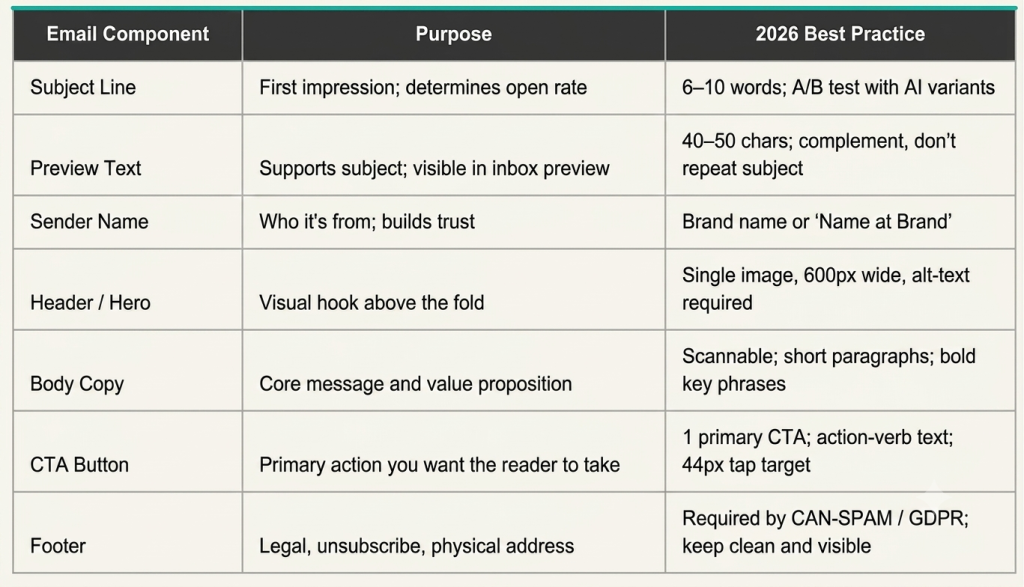
Email Structure from Best Marketing Email Examples:
The following picture is a practical guide of ‘how to create an email campaign’.
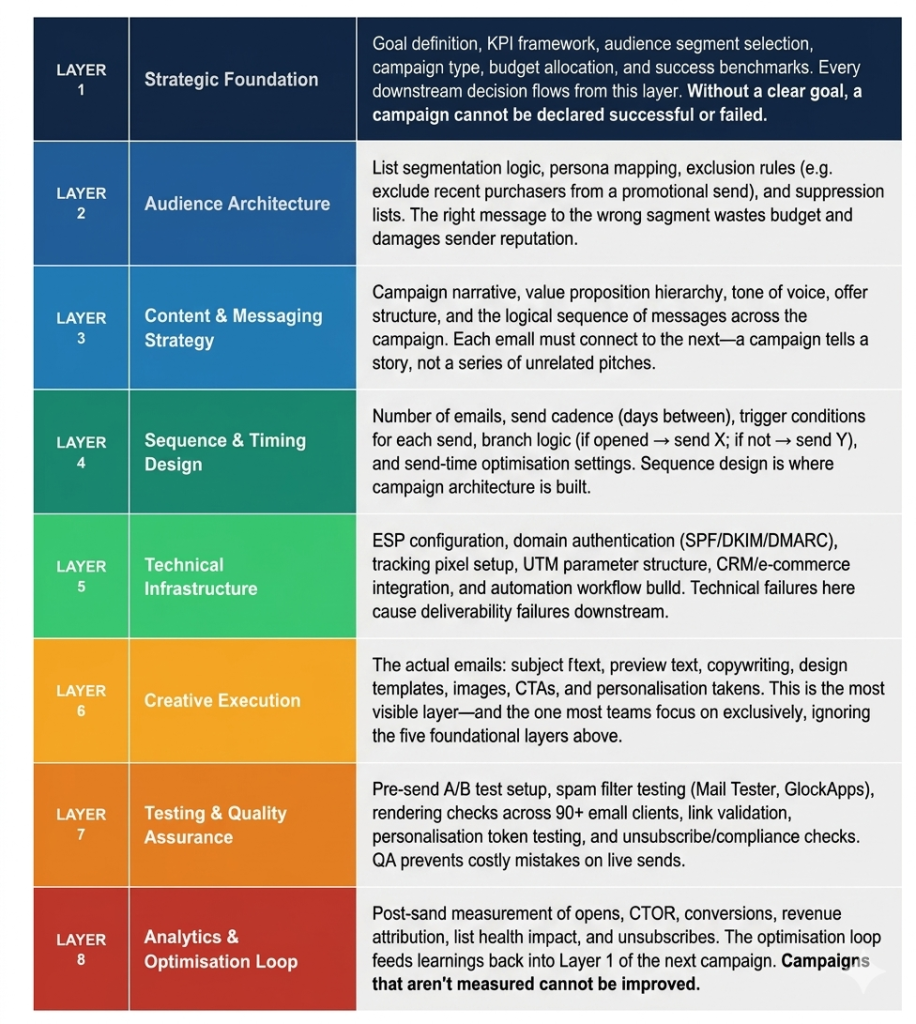
The above architecture is notably a guide for running free email campaigns. Similarly, many elements of email structure are extracted from best marketing email examples, which serves as the catalyst in the campaigning process for the businesses.
Pre-requisite of Running Email Campaigns:
1-Building Deep Insights into Your Audience
Knowing your customer is critical for sending emails. It is a pre-step towards personalized email campaigns. Here it means that you should not only be aware of the demographics like age or location but also about the customer purchase history or real time interests- behavioral interests. These are the things which make the campaigns successful.
2-Defining a Clear and Meaningful Purpose
For the purpose of receiving specific targets, marketers must have assigned clear and objective goals which will act as a chain in achieving long-term ambitions.
3-Curating a Quality and Engaged List
By keeping a small and manageable list of users can aid in optimizing results, as these will be active and responsive users. Knowing your customer can help in better pitching and gaining maximum results. Remember to practice regular hygiene by removing inactive contacts to keep your community healthy.
4-Selecting the Right Technology for Your Needs
Using the most fitted tool for email campaigns is impactful in achieving specific goals. It is necessary, firstly, to analyze tools based on their deliverability rates, automation depth, and their alignment with the budget as the list grows. Some of the tools for particular needs are:
Klaviyo – best for e-commerce
Hubspot – helpful in B2B workflows
Mailchimp – simple & user-friendly templates
5-Maintaining Legal and Privacy Standards
It is crucial to uphold ethical guidelines and legal requirements. As this action will ensure to protect the privacy of the users. Showing compliance to the principles of internet of different regions will not only enable authenticity but also ensure the proper reach towards the consumers.
6-Verifying Your Domain to Build Trust
Having an authenticated domain will help emails landing directly into the inbox rather than being labelled as spam. As this will, further, ensure the frictionless conveyance of messages to the readers.
7-Designing a Comfortable Experience for Mobile Readers
Before sending the emails, check if the email layouts are mobile friendly or not as most of the emails are opened on mobile devices Marketers should incorporate single-column layouts that do not collapse awkwardly, ensuring the size of fonts are easy to read and making buttons large enough to tap easily.
Methods of Executing Email Campaigns:
1-Utilizing the Batch & Blast Method for Broad Outreach
One of the methods of executing email campaigns is the ‘Batch & Blast’. Using this method, marketers formulate a single message and share it to the broad list at once. It is the simplest approach to share newsletters, helpful company announcements, or major events where individualized personalization might be impractical.
2-Leveraging Automated Drip Sequences for Continuous Support
Businesses can execute a campaign with pre-written emails, being delivered at specific intervals followed by specific events such as new sign up. Once these sequences are established, emails start receiving to the users without manual intervention, providing a smooth guide to the users over time.
3-Executing Behavioral Trigger Execution for Timely Responses
This method involves responding thoughtfully to the real-time users’ actions taken on your website or app. By using tracking tools, you can automate relevant notes, such as a supportive reminder sent within one hour of a user leaving an item in their cart.
4-Applying A/B and Multivariate Testing for Refined Performance
By adopting multiple variations to your professional emails can show what resonates with the customer’s inclinations. Multiple comparing variables like subject lines, sender names, or button colors, ensure future communications are more aligned with recipients’ preferences.
5-Adopting AI-Powered Personalization for Scalable Individual Connections
Modern techniques such as generative AI for scaling personalization can be advantageous in securing targeted goals for the start-ups. As this campaign will ensure that the customers get desired emails- showing products or services list from user’s history or searches on search engines.
6-Leveraging Send-Time Optimization (STO) for Convenient Delivery
By using data and algorithms in order to identify the customer peak engagement time, you can run scheduled campaigns. This will help businesses that their messages are reached at the convenient time. This strategy can help in obtaining the results of best email marketing campaigns.
7-Routing Transactional Emails via Dedicated API or SMTP Infrastructure
For essential information like order confirmations or password resets, you can ensure dependable delivery by using a dedicated service. By separating these notifications from your regular marketing messages, you protect your reputation as a sender and ensure customers receive vital information without delay.
8-Integrating Multi-Channel Sequencing for Integrated Outreach
One of the methods involves outreaching customers via email alongside other gentle touchpoints like SMS or push notifications. This helps businesses reach their target even if their emails are missed by the consumers
When you need a Marketing Agency for Email Campaigns:
According to the reports, businesses may need an agency for running email campaigns for the following reasons:
1-Underperforming Metrics:
When businesses are unable to obtain their targeted results, showing below 20 % email open rates and less than 2 % click- through rates.
2-Deliverability Struggles:
Emails are frequently landing in spam folders or failing critical authentication mandates.
3-Excessive Internal Costs:
Your team spends over 20 hours per month on email, creating a significant opportunity cost for your business, highlighting no measurable ROI after 90 days of emailing.
Manage Your Email Campaigns with Rankforte:
Our Email Marketing Services are;
1-Campaign Strategy & Audit
We start with a comprehensive audit of your existing email programme—analysing deliverability,engagement metrics, list health, and automation coverage. From there, we build a custom 90-day roadmap aligned to your revenue targets. No templates; every strategy is bespoke.
2-Copywriting & Template Design
Our email copywriters specialise in persuasion architecture—crafting subject lines, preview text, and body copy that moves people through the funnel. Every template is built mobile-first, deliverability-tested, and rendered across 90+ client/device combinations before deployment.
3-Automation Architecture & Setup
We design and build end-to-end automation flows: welcome series, abandoned cart, post-purchase,re-engagement, lead nurture, and custom behavioural triggers. Includes full ESP configuration, CRM integration, and event tracking setup.
4-Analytics, Reporting & Optimisation
Weekly performance dashboards tracking opens, clicks, CTOR, revenue attribution, list growth, and deliverability metrics. Monthly strategy reviews with actionable optimisation recommendations. We tie email performance directly to business revenue, not vanity metrics.
5-Deliverability Management
Domain and IP warm-up protocols, sender reputation monitoring, blacklist surveillance, spam filter testing, and DMARC enforcement management. We maintain your inbox placement rates above 95%—a level most in-house teams cannot consistently achieve.
6-AI Personalisation & Advanced Segmentation
Leveraging Klaviyo AI, HubSpot Breeze, and proprietary segmentation models, we implement dynamic content blocks, predictive product recommendations, and send-time optimisation at scale.Your subscribers receive emails that feel individually crafted—because they are.
7-List Growth & Health Management
Strategic lead magnet development, opt-in form optimisation, and multi-channel list growth campaigns. Ongoing list hygiene: suppression management, re-engagement sequences, bounce handling, and GDPR/CAN-SPAM compliance maintenance.
FAQs
1-How to run email campaign
Execute your campaign by following a six-step lifecycle: plan your goal and audience, create the content, test for quality, deploy via an ESP, and analyze the results for future optimization.
2-How to create an email marketing campaign
Create a campaign by building an eight-layered strategic architecture (above mentioned) that prioritizes your goal, audience logic, and messaging sequence before designing the creative elements.
3-How much do email campaigns cost
In 2026, professional email management costs range from $1,500–$5,000 for a monthly agency retainer to over $8,000 for a single in-house specialist’s salary.
4-How do email campaign works
Email campaigns work as an interconnected strategic system of sequenced, permission-based messages delivered to targeted segments to achieve a measurable business objective